Madhyamik 2027 Selection Test: Turn Mistakes into a Revision Plan
Use your Madhyamik 2027 selection-test answers to spot lost marks, repair weak topics and plan focused revision with practical checks for parents.
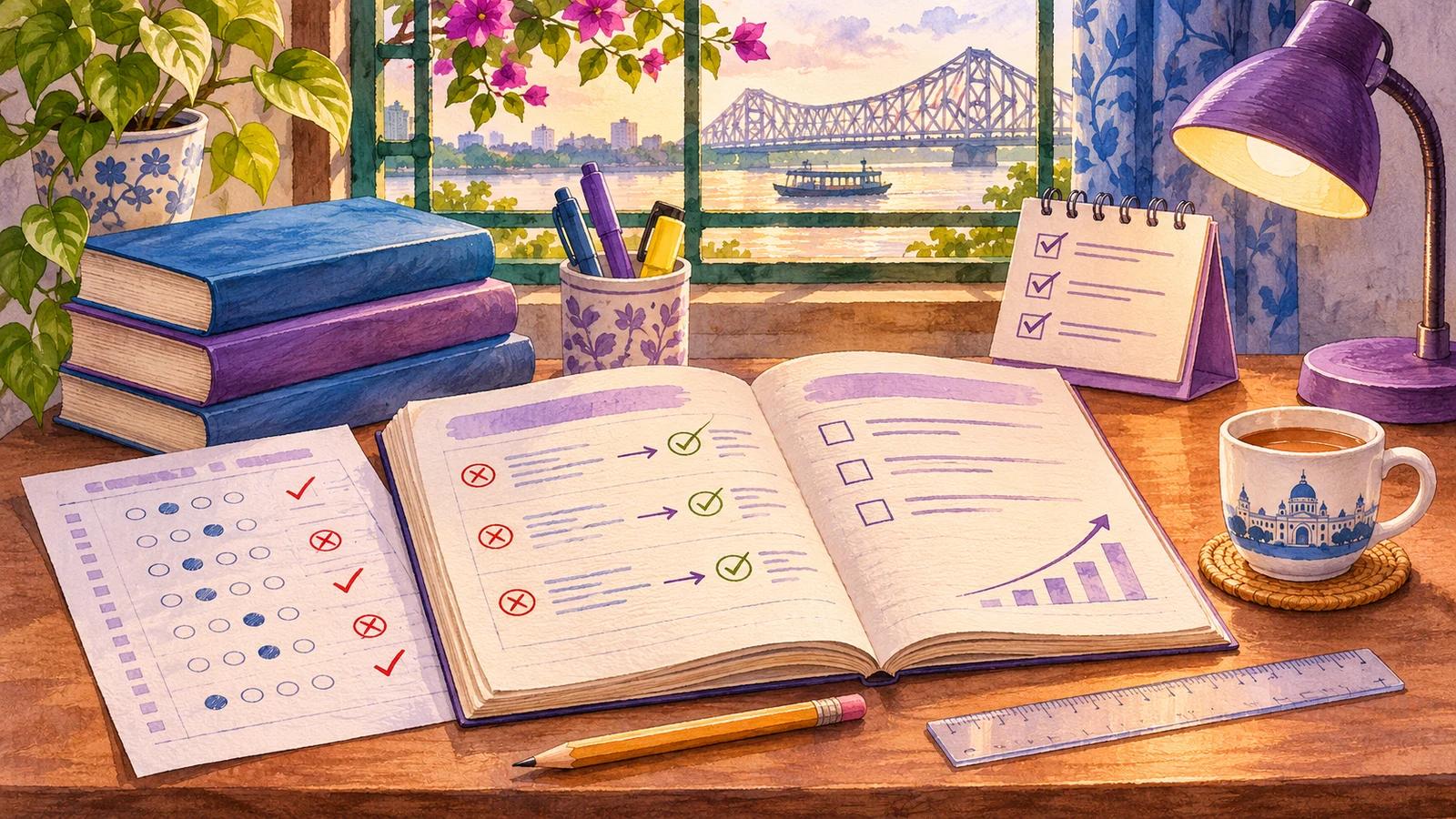
A Madhyamik selection-test paper can tell you more than a total score. It can show where you knew the chapter but missed the question, where a calculation broke down, and where your revision has not yet reached. For Class 10 students in Behala and across Kolkata preparing for Madhyamik 2027, the useful next step is to turn that evidence into small, specific tasks. This guide explains how to review completed papers without letting yesterday’s mistakes take over preparation for tomorrow’s exam. You can begin with your own recollection, then improve the review when your school returns marked answers.
Confirm the selection-test schedule with your school
As checked on 19 November 2026, WBBSE’s notification dated 16 January 2026 places the Class X selection test for Madhyamik 2027 between 17 and 30 November 2026. The school’s subject-wise routine tells you when your own papers take place. This is the selection-test window, not the final Madhyamik examination timetable.
A further WBBSE notice dated 3 November 2026 addresses school question-paper preparation and submission. It requires adherence to the prescribed Class X curriculum and syllabus, and says schools should not hold a collective or combined test as a cluster, with or without an external agency. For students, the practical implication is to follow your school’s instructions and prescribed material rather than treating a circulating paper as a universal selection-test paper. Ask your school about any uncertainty concerning coverage, attendance or results.
Between papers, capture the problem and move on
If more selection-test papers remain, keep the first review brief. After returning home, write down two or three questions that troubled you and what happened: you forgot a term, ran out of time, or could not choose a method. Label these as provisional observations. Memory after an exam is imperfect, so do not calculate a definite score from a corridor discussion or an unofficial answer circulating online.
Then put that paper aside and prepare for the next subject. A long argument about one answer can consume the only useful study block before tomorrow’s test. If a concern needs a teacher’s attention, note the question and ask at an appropriate time. Parents can help by asking what support is needed for the next paper instead of repeatedly asking how many marks were lost. Save the detailed analysis for when the examination sequence allows it.
Build a lost-marks record from the returned script
When marked scripts or teacher feedback become available, sit with the question paper, your answer, the prescribed textbook and a blank page. Record the question number, chapter, marks lost, likely reason and one repair task. If the marking is unclear, ask the subject teacher to explain the missing element before deciding that the answer was correct or the marking unfair. A low total alone cannot tell you what to practise.
Keep the record short enough to use. You do not need to copy every question or decorate a new notebook. One line such as ‘algebra: changed sign while moving a term; solve four similar equations and check by substitution’ is more useful than ‘careless mistake’. Separate answers you genuinely attempted from questions you left blank, because those may need different repairs.
- Concept gap: you could not explain the idea even without a time limit.
- Recall gap: you recognised the topic but could not retrieve a fact, term or step.
- Method or calculation error: the approach started correctly but failed at an identifiable point.
- Question-reading error: you missed an instruction, condition or required part.
- Timing or presentation issue: you left work unfinished or did not communicate the answer clearly.
Match each repair task to the subject
For Mathematics, redo the question on a clean page without looking at the corrected solution. Write the reasoning beside the step that originally failed, then attempt a similar problem with different values. If you can only reproduce the teacher’s exact working, the method needs more practice. Check units and intermediate calculations where relevant; do not rely on a matching final answer to prove that every step is sound.
For Physical Science and Life Science, distinguish an explanation problem from a recall problem. Try explaining a concept aloud, completing a numerical with working, or drawing and labelling a diagram from memory as appropriate to the question. Check against prescribed material and teacher feedback. For History and Geography, identify whether your answer lacked a relevant point, sequence, explanation or correctly located information. Practise the particular response that was weak rather than rereading the whole chapter automatically.
For language papers, review what the task actually asked you to produce. Compare your grammar correction, comprehension answer or written composition with the teacher’s comments. Rewrite one weak paragraph or answer, keeping the required length and task in view. These are suggested study methods, not a new board marking scheme; your school’s guidance should determine the expected answer format.
Choose three priorities instead of restarting everything
Once the selection tests finish, choose a manageable first set of repairs. Give priority to a recurring error, a concept needed for several other topics, and an answer type you repeatedly left incomplete. This is a planning suggestion, not a prediction of chapter weightage. Continue touching stronger subjects too, so that the repair plan does not create fresh gaps elsewhere.
For example, suppose the record shows sign errors in algebra, incomplete explanations in Life Science and rushed writing in English. One study block can address algebra with checked solutions; another can rebuild a short science explanation; a later session can practise a timed writing task. The next review should ask whether those exact problems improved. ‘Finish all weak chapters this week’ gives you much less direction.
Use a repair-and-retest cycle that fits Kolkata school days
Fit the work around your real school, tuition and travel commitments. On a busy day, a focused 25-minute repair task may be more manageable than a full paper. Reserve longer uninterrupted sessions for timed sections or complete papers when you have enough time to review them afterwards. The durations below are examples you can adjust with a teacher, not mandatory targets for every student.
- First session: spend about 15 minutes reviewing the concept and 20 minutes solving a few relevant questions.
- Next session: try one comparable question without notes and explain why your method works.
- After a few days: mix the repaired topic with another chapter so the method is not obvious from the exercise title.
- At the weekly review: mark the error as resolved, improving or still needing help, based on your new answers.
Bring precise questions to a teacher or tuition session
Take the original question, your attempted answer and the specific step you cannot explain. ‘Why does this sign change here?’ or ‘Which part of the question did my paragraph leave unanswered?’ gives the teacher something concrete to work with. After the explanation, solve a fresh example independently. Keep that new attempt beside the old one so you can see whether the difficulty has actually changed.
If several papers show large gaps, ask for help deciding the order of work instead of buying another stack of practice books immediately. Students and parents in Behala can contact Path Creator Tutorials with their subjects and current difficulties to discuss suitable tuition support. Bring the school’s feedback so the conversation begins with the student’s actual needs. Confirm board coverage, batch suitability and available support directly with the team.
Give parents a useful weekly checkpoint
Once a week, ask the student to show one answer they improved, one error that remains and one question to take to a teacher. Check that the next week’s plan leaves room for schoolwork, meals, rest and travel. Compare the student’s new work with their earlier attempt rather than with another child’s marks. A completed repair task is a clearer sign of progress than the number of hours spent beside an open textbook.
Keep school administration separate from the revision discussion. Any concern about selection-test results, further assessment or permission to appear must go to the school; this article does not establish eligibility or a universal pass threshold. Recheck official notices and school instructions before acting on a forwarded message. The purpose of the review is to improve the next answer, while the responsible authority confirms the rules.
Quick answers
Common questions
When is the Madhyamik 2027 selection test?
WBBSE’s 16 January 2026 notification sets the Class X selection-test window at 17–30 November 2026. Confirm your subject dates and any subsequent instructions with your school. These are selection-test dates, not the final Madhyamik timetable.
What should I do if my selection-test marks are low?
Review the marked answers with a teacher and identify specific causes before changing your study plan. Choose a few repair tasks, then test them with fresh questions. Ask the school directly about any result-related administrative requirements.
Can I start reviewing before the school returns my answer script?
Yes. Record questions and difficulties you remember, but treat that record as provisional. Avoid assigning yourself a definite score from unofficial answers. Update the record when marked scripts or teacher feedback are available.
Should I solve full papers every day after the selection test?
Choose practice according to the problem. Use short exercises for a specific concept or repeated calculation error, timed sections for pacing, and full papers when you can review them properly. More papers alone will not explain why an answer went wrong.
Does a selection-test score decide my final Madhyamik marks?
Do not treat a school selection-test score as a prediction of your final board result. Use it to identify what needs work. For rules about selection, eligibility or any further school assessment, obtain the current instructions from your school and WBBSE.
Verified references