CBSE Class 12 Physics Practical 2027: Record, Graphs and Viva
Prepare for CBSE Class 12 Physics practicals in 2027 with a record audit, graph checks, viva practice and a manageable plan before your school assessment.
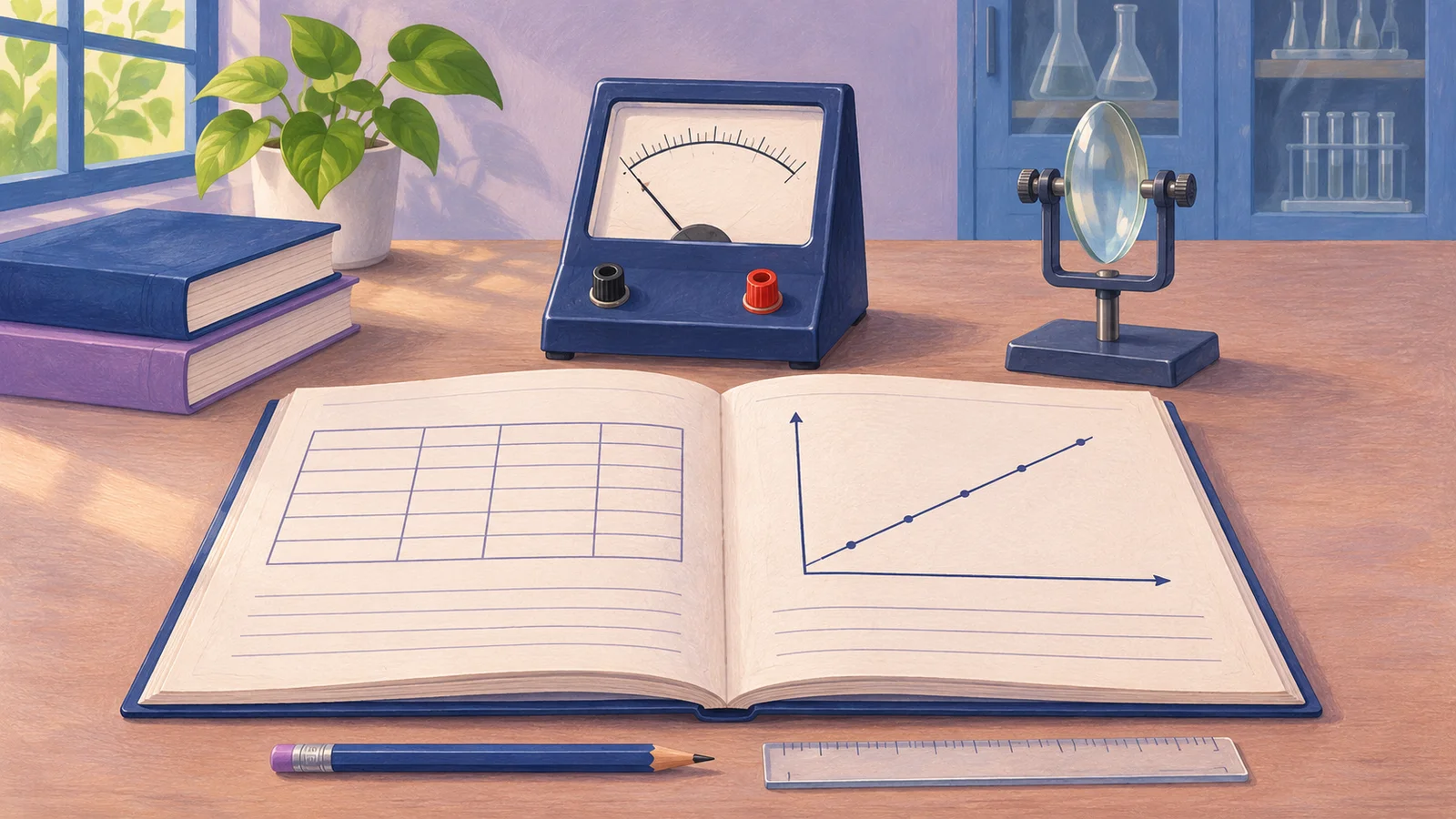
A completed Physics practical file can still leave you unsure when someone asks why you used a particular graph or how you obtained a result. Practical preparation needs both a reliable record and the ability to explain your own work. For CBSE Class 12 students in Behala and across Kolkata preparing for 2027, late November is a useful point to check what remains unfinished before school assessments approach. This guide shows how to audit your record, reconnect observations with concepts and practise short viva answers. It is a preparation method, not a prediction of the experiment you will receive.
Confirm the assessment window with your school
CBSE’s marks-distribution circular dated 5 November 2026, listed on its examination circulars page on 6 November, gives 1 January to 13 February 2027 as the practical and internal assessment window for regular-session schools. It gives a separate 9 November to 19 December 2026 window for winter-bound schools. These are assessment windows, not an individual student’s appointment. Confirm your subject date, reporting time and submission arrangements directly with your school.
Use the official CBSE circular and the Class XII Physics section of the 2026–27 curriculum together. The Physics practical evaluation scheme totals 30 marks: two experiments worth 7 marks each, the practical record worth 5, one activity worth 3, the investigatory project worth 3 and viva worth 5. Check later official updates before publication or assessment. The preparation suggestions below do not replace the prescribed experiment list or your teacher’s instructions.
Audit the record before rewriting anything
Spread your practical record, project and school checklist on the desk. Make a short inventory with four columns: item, work completed, correction needed and question for the teacher. Open every entry rather than relying on an index tick. Look for missing observations, incomplete calculations, graphs without units and comments that you have not addressed. Ask your teacher how to complete missed laboratory work; copying another student’s readings does not resolve that gap.
For Class XII, the published Physics curriculum asks for a record of at least eight experiments, four from each section, at least six activities, three from each section, and the report of the project carried out. Compare those requirements with your own record and confirm the applicable arrangements with school. Keep corrections legible and follow the format your teacher accepts. Rewriting an entire notebook for appearance alone can consume time needed to understand the work.
- Flag missing or unchecked entries for a teacher discussion.
- Check that every observation table has named quantities and units.
- Trace each final result back to the readings and calculation that produced it.
- Keep project evidence and the explanation of your own contribution together.
Build an explanation card for each experiment
For each experiment you have performed, prepare a small revision card in your own words. Include the aim, the physical principle, the quantities measured, the calculation or graph used and one meaningful precaution. Add a sketch of the apparatus if it helps you explain the arrangement. Keep the card short enough to review without turning it into a second practical file.
Close the record and describe the experiment to a classmate. Can you say what you change, what you measure and what you keep as consistent as possible? If you can recall a formula but cannot identify the measured quantities in it, return to your observation table. Practise the procedure with school apparatus only under the teacher’s supervision; a spoken rehearsal at home supports understanding but does not replace laboratory experience.
Read a graph as evidence, not decoration
A graph should help explain a relationship between measurements. Before plotting, identify the horizontal and vertical quantities, choose a readable scale and label both axes with units. Check a few plotted points against the table. When estimating a straight-line gradient, use well-separated points on the best-fit line rather than automatically joining two neighbouring observations. Follow your teacher’s method for the particular experiment.
Consider an original practice example: potential difference V is on the vertical axis and current I on the horizontal axis. Two points on a straight best-fit line are (0.10 A, 0.60 V) and (0.30 A, 1.80 V). The gradient is (1.80 − 0.60)/(0.30 − 0.10) = 6 V/A, or 6 ohms. Reversing the axes changes the meaning of the gradient. This arithmetic exercise is not a set of readings to copy into a practical record.
After calculating, explain what the gradient represents and why its unit makes sense. If a point looks unusual, check the original reading and plotting before deciding what to do. Do not alter a recorded observation simply to make a line look perfect. Ask your teacher how to report discrepancies honestly.
Prepare viva answers from your actual work
Use a three-part answer: state the idea, connect it to the apparatus or observation, then explain the consequence. For example, instead of only naming a precaution, describe which reading it protects and how an error might arise without it. Keep the first answer brief so that the examiner can ask a follow-up. These are practice prompts, not a guaranteed question bank.
Choose one record entry and ask a friend to vary the wording of the question. Explain why the instrument or method was suitable, what the measured quantity means and how you checked the result. If you are uncertain, identify the part you understand and ask for clarification during practice. Memorised paragraphs are difficult to adapt when a question refers to a specific observation in your own file.
- What physical relationship is this experiment investigating?
- Which quantity did you measure directly, and which did you calculate?
- What does the graph’s gradient represent with these axes?
- Which precaution addresses a specific source of error?
- What can your result support, and what can it not establish?
Know the project you submit
Treat the investigatory project as a small investigation you can defend. Prepare a short explanation of its question, method, observations and conclusion. Separate what you measured from information you read elsewhere, and acknowledge sources you used. If the work involved other people, be clear about your contribution. Discuss incomplete or unsuitable work with your teacher before producing a replacement.
Check whether the conclusion actually follows from the evidence. A small set of observations does not justify a claim about every possible condition. Be ready to mention a limitation and one sensible improvement. A neat cover helps organisation, but it cannot answer questions about the method. Rehearse explaining one table, photograph or graph from the project without reading a prepared speech.
Use four short preparation blocks this week
Fit preparation around school, travel and theory revision. As a suggested starting point, use four blocks of about 30–40 minutes, adjusting them to your workload. First audit the record and write down teacher queries. In the second block, make explanation cards for the entries you understand least. Use the third for one graph and its interpretation. In the fourth, rehearse viva and project explanations with someone who asks follow-up questions.
Leave apparatus practice for an authorised school laboratory session. At the end of the week, record what is now complete and what still needs help. Avoid turning every evening into file decoration while theory revision stalls. If a concept keeps blocking your explanation, revise that specific chapter idea and return to the experiment. Your practical and theory work can reinforce each other.
Agree on the final checklist before assessment day
Ask your school which materials and documents to bring, when records must be submitted and what arrangements apply to your batch. Keep the confirmed instructions in one place. If you need an accommodation or have missed a laboratory session, raise it early with the school rather than assuming a general online checklist covers your circumstances.
Parents can help by checking that these practical arrangements are clear and giving students time to explain their work aloud. Students in Behala who need help connecting observations with Physics concepts can contact Path Creator Tutorials to discuss subject support. Bring the relevant record entry and a precise doubt, such as why a gradient has a particular unit. School staff remain the source for assessment scheduling and submission requirements.
Quick answers
Common questions
When are CBSE Class 12 Physics practicals in 2027?
The 5 November 2026 CBSE circular gives 1 January to 13 February 2027 for regular-session schools, with a separate winter-bound window. Your school confirms your individual Physics practical date and reporting instructions. Recheck for later notices.
Is completing the Physics practical file enough?
The published scheme also assesses experiments, an activity, the project and viva. Use the record to practise explaining measurements and results, and ask your teacher for supervised apparatus practice where needed.
How should I prepare for the Physics practical viva?
Work from experiments and the project you have actually completed. Explain the principle, measured quantities, graph, precautions and result in your own words. Practise follow-up questions rather than learning a fixed answer bank.
What if my practical record has missing experiments?
List the gaps and speak to your school teacher promptly about completing the required work. Do not invent observations or copy someone else’s data. Follow the school’s correction and submission instructions.
Can I prepare for practicals alongside board theory?
Yes. Link each record entry to the relevant theory concept, then use short separate blocks for graph interpretation and spoken explanation. Keep laboratory practice supervised and protect time for written theory work.
Verified references